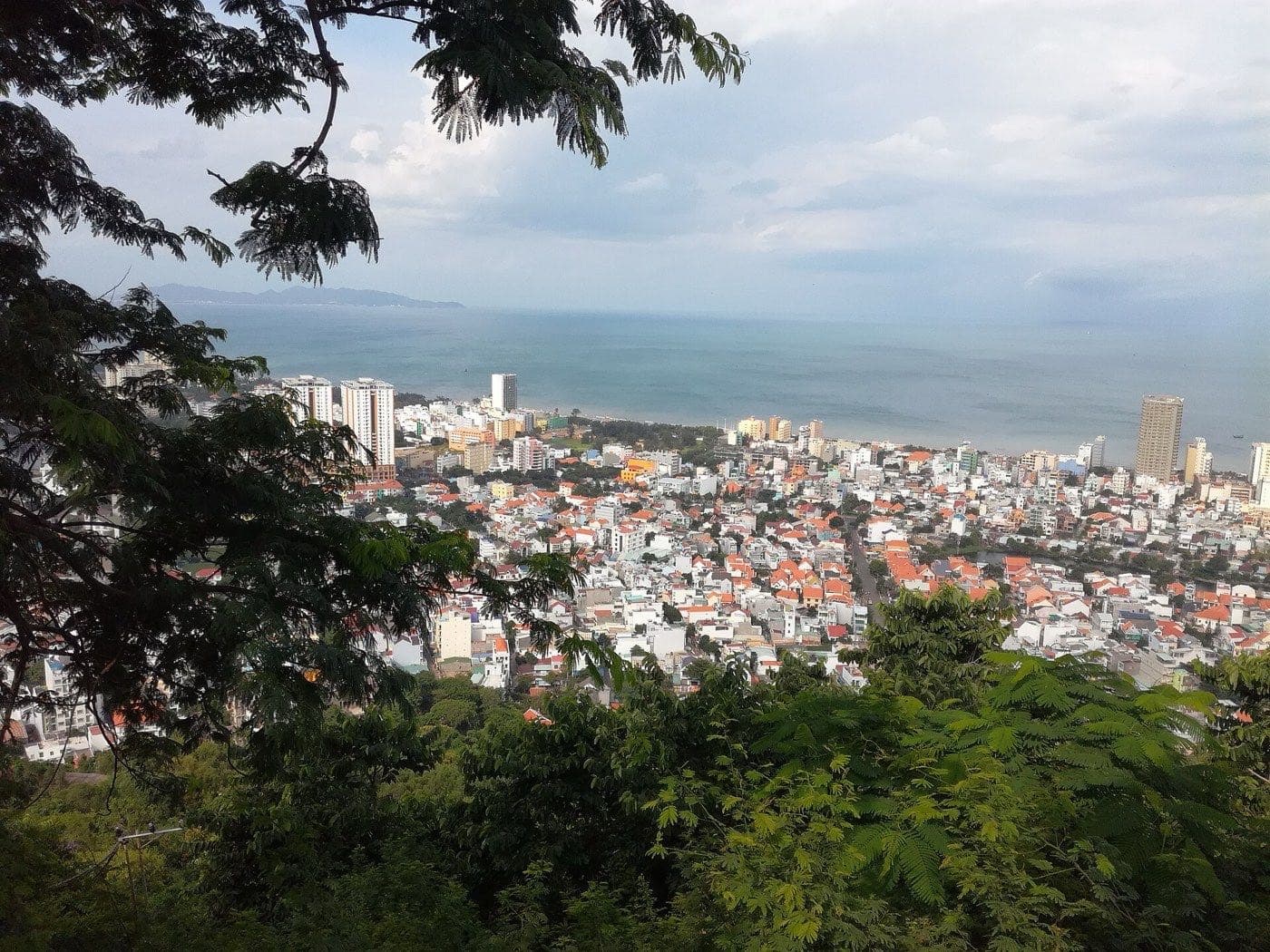
The beaches of Vung Tau: which one to swim on, and are they any good?
Six beaches sit inside the city, and you can properly swim on just one: Back Beach. The city sand is ordinary and, on busy weekends, can turn murky and littered — the river mouth and port sit right there. For cleaner sand, go up the coast to Ho Tram, Ho Coc or Long Hai. Vung Tau is a handy day-escape from Ho Chi Minh City (125 km, about two hours by ferry), not a postcard-beach destination. Below: a rundown of every beach with 2026 prices and a comparison table.

Bãi Sau (Back Beach) is 8 km of sand on the east coast. The other beaches are for walking, chasing sunsets and taking photos. Swimming, not so much: the port is close, ships ride at anchor, and murky Mekong tributaries feed the bay.
From Ho Chi Minh City this is the easiest coast to reach: a ferry from Bạch Đằng pier takes about two hours. On weekdays the beaches are empty and calm; on weekends they are shoulder to shoulder. For water clarity Vung Tau loses to Phu Quoc, and for service it loses to Nha Trang. But no other Vietnamese beach resort sits this close to Ho Chi Minh City — that is the whole point of the place.
Prices verified in March 2026. Rough rate: ~26,000 VND = $1.
Which beach to pick — the comparison
Six beaches in the city plus three further up the coast, 17 to 46 km away as the crow flies. Tap a marker on the map for details.
- Back Beach (Bãi Sau): ~8 km of pale sand | 2 km from centre — Loungers, cafes, watersports | For everyone
- Front Beach (Bãi Trước): Dark sand | City centre — Promenade, park, restaurants | Sunsets, strolls
- Bai Dua (Bãi Dứa / Pineapple Beach): Rocks + pools | 1.5 km from centre — No facilities | Photographers, couples
- Bai Dau (Bãi Dâu / Mulberry Beach): Sand and rocks | 3 km — Minimal facilities | Quiet, temples
- Nghinh Phong (Nghinh Phong Cape): Rocks, little sand | 1.5 km — No facilities | Solitude, photos
- Long Hai (Long Hải): Wide, clean | ~17 km as the crow flies — Camping, cafes | Cleaner water
- Ho Coc (Hồ Cốc): Turquoise water, wild beach | ~46 km as the crow flies — Minimal facilities
- Ho Tram (Hồ Tràm): Groomed sand, resorts | ~41 km as the crow flies — Pools, comfortable stay
| Beach | From centre | Sand & entry | Facilities | Swimming | Best for |
|---|---|---|---|---|---|
| Back Beach (Bãi Sau) | 2 km | Pale, gentle | Loungers, cafes, slides | Yes | Families, swimmers |
| Front Beach (Bãi Trước) | 0 km | Dark | Promenade, park | No | Strolls, sunsets |
| Bai Dua (Pineapple) | 1.5 km | Rocks + pools | None | With care | Photographers, couples |
| Bai Dau (Mulberry) | 3 km | Sand and rocks | Minimal | With care | Quiet, temples nearby |
| Nghinh Phong | 1.5 km | Rocks, little sand | None | With care | Solitude |
| Long Hai | ~17 km | Wide, clean | Camping, cafes | Yes | Cleaner water, sport |
| Ho Coc | ~46 km | Turquoise water | Minimal | Yes | Wild getaway |
| Ho Tram | ~41 km | Sand, well-kept | Resorts, pools | Yes | Comfort stay |
In short: to swim — Back Beach or out of town, for sunsets — Front Beach, for photos — Bai Dua, for quiet and clean water — Long Hai or Ho Coc.
Back Beach (Bai Sau) — the main beach

The only beach in Vung Tau people actually come to swim on. Eight kilometres of pale sand, a gentle bottom, loungers, cafes and pools right on the shore. The shallows run out for tens of metres — a child can splash around knee-deep fifty metres from the sand.
The beach stretches south to north along the east coast of the peninsula. The Thùy Vân road runs along it, and everyone calls it Back Beach. It is the city's most popular beach, and on weekends there is barely room to move.
Facilities and prices
- 2 loungers + umbrella (day)150,000 VND ≈ $6
- Open-air pool75,000–150,000 VND ≈ $3–6
- Beach cafe meal (pho, rice)40,000–80,000 VND ≈ $1.60–3.20
- Coconut20,000–30,000 VND ≈ $0.80–1.20
The southern end (near the mountain) is the loudest. Cafes, street kitchens, slides, trampolines, jet-ski and kayak rental. Plastic tables sit right on the sand: you take a seat and order phở or grilled seafood with the waves in view.
The northern end is calmer. Spread a towel and there is nobody within five metres. There are loungers too, just fewer. This is where people come to swim without the crowd.
Imperial Beach Club opens at 7:00, the restaurant at 10:00. The day pass covers a shower, pool and towels. The front row of loungers is gone by 9 a.m.
Who it suits
- With kids: shallow water, a gentle entry, slides and trampolines at the southern end. The sand is firm, so a stroller won't sink
- Want comfort: loungers, cafes and pools within a few steps
- On a budget: spread a towel on the sand, grab a coconut for a dollar and forget the lounger
- Winter surfing: from December to February the waves pick up, drawing kite- and windsurfers. Gear rental from 300,000 VND (~$12) a session
The downsides of Back Beach
Litter. On weekends tens of thousands of Vietnamese pour in from Ho Chi Minh City. What they leave on the sand: bags, cups, wrappers. Cleaners can't keep up. On weekdays it is clean.
Vendors. Sellers of fruit, corn and sunscreen come by every 10 minutes. A polite no works, but by the fifth round it wears thin.
Winter waves. December–February is dry and sunny, but the surf on Back Beach rises. Great for surfers. Awkward with a child — the waves knock you off your feet even in the shallows.
Rip currents. In heavy surf, Back Beach gets rip currents — narrow channels that pull you away from shore. Lifeguards fly flags for it: a red flag means stay out.
If you do get caught, don't fight the pull — swim parallel to the shore until you clear it. Watch the flags, not just the waves.
Murky water. With the river mouth and the port right here, the sea is never crystal-clear, even on the best days. It is acceptable when calm, and cloudier after rain and on weekends.
Petty theft. Don't leave your phone or wallet on the towel. Use a locker (the beach clubs have them) or ask someone in your group to keep an eye out.


Front Beach — for sunsets, not swimming

Front Beach Bãi Trước (also Tầm Dương) is the first thing you see if you arrive by ferry. It looks great. But keep out of the water.
The crescent-shaped beach is wedged between the Tao Phùng and Tượng Kỳ hills. Facing it is the fishing port, dozens of boats at anchor.
The water is murky and in places smells of diesel. The sand is dark, but you still won't want to swim.
The sunsets here are the best in town. The sun drops straight into the sea, with not a single tower block on the horizon. Along the shore runs a park with paths, benches and small restaurants. Dark sand against an orange sky looks like Iceland, only with palm trees.
In the evening the promenade comes alive. After 5 p.m. it fills with families, joggers and couples. Vietnamese play badminton on the sand and kids fly kites. Cafes push their tables right down to the water.
What to do here:
- An evening stroll along the promenade and park
- Dinner at a cafe facing the sunset (roughly 100,000–200,000 VND / ~$4–8 for two)
- A morning run — the park paths run for 2 km
- A photo shoot against the dark sand and hills
Swim? No. Back Beach is 2 km away, 10 minutes by Grab.
At a strong low tide about a hundred metres of muddy seabed is exposed. The sight is, to put it mildly, not beach-like. Check the tide tables before you head out.
Fast Track — no queue at the border
5–10 minutes instead of an hour in the immigration queue
from$11per passenger
Bai Dua — Pineapple Beach, for photographers

Bãi Dứa hides between the Front and Back beaches, at the foot of the Small Mountain, next to Nghinh Phong cape. It is named after the wild pineapple that once grew on the rocks by the water. The pineapples are long gone; the name stayed.
A beach in the usual sense this is not. Boulders the size of a car are scattered along the shore, and between them sit small coves of clear water.
At low tide the rocks are exposed and it turns into a kind of stone garden: shapes carved by the waves over thousands of years, silhouettes against the sea and sky.
The light is good most of the day. In the morning it is soft and golden, falling across the wet rocks — photographers show up at dawn. In the evening the palette shifts to pinks and oranges, reflected in the pools between the boulders.
You can dip in, but carefully: only in the pools, only when the sea is calm. The bottom is rocky and the entry uneven. There are no loungers, showers or cafes. The nearest shop is a 10-minute walk. But there is almost no one around either.
When to come: December–April, strictly at low tide.
Who it suits: photographers, couples, anyone after a non-touristy spot. Not with kids: rocks, currents, no lifeguards.
Bai Dau — the quiet beach below Big Mountain

Bãi Dâu (Mulberry Beach) sits on the western side of Big Mountain. Tour groups don't make it out here, and that is the whole appeal. A quiet shore and a horizon with not a single tower block. The sunsets are laid out right in front of you: sea, sky and an orange band on the horizon.
The beach is small, 300–400 metres. The sand is lighter than Front Beach but darker than Back Beach. The shore is rocky in places, so wade in carefully — there are no lifeguards. The water is roughly like the city's — not perfect, but fine.
On the surrounding hills stand three religious landmarks worth a look:
- Quan Âm Nam Hải Pagoda — a Buddhist temple overlooking the sea. The white statue of the goddess of mercy is visible from afar
- Đức Mẹ Bãi Dâu pilgrimage centre — a 20th-century Catholic shrine on the slope of Big Mountain: a 1926 chapel and a large statue of the Virgin Mary above the sea. Quiet, cool under the trees
- Hưng Thạnh Tự Temple — a small temple
Between swims you can climb the steps to the pagoda, stand in the quiet and head back to the water.
There are almost no facilities: a couple of cafes nearby, and that is it. Bring water and a snack. Toilets are only in the cafes around the corner.
Who it suits: anyone who values quiet over loungers. Morning walks, a book by the water, meditation. Not for an active beach day — there is simply nothing to do.
Nghinh Phong — a tiny beach for loners

Right next to Pineapple Beach, by the cape of the same name. Small, rocky, no facilities at all. Even in peak season it is empty. Want to be alone with the sea, with no one offering you corn? This is your spot.
Nghinh Phong cape means "wind-welcoming." The rocks drop into the sea, the wind never lets up and spray shatters on the stones. It is beautiful. You can dip in the pools when the sea is calm, but the bottom is rocky and there are no lifeguards.
A place for contemplation, not swimming. Stop by for half an hour on the way from Bai Dua to Back Beach.
Beaches out of town — Long Hai, Ho Coc and Ho Tram

The city beaches are a trade-off: close, but so-so water. If sea clarity is your top priority, head out of town. Three options further up the coast.
Long Hai — a clean alternative nearby
Long Hải is a village about 17 km across the bay as the crow flies; the road is longer (taxi 200,000–300,000 VND / ~$8–12). The water here is noticeably cleaner. The sand is coarse and brownish, but you can see the bottom at waist depth. A wide flat shore — you can pitch a tent right on the sand or paddle a kayak.
Long Hai is often recommended to anyone let down by the city beaches. A few cafes on the shore, a mattress to rent. It doesn't match Back Beach on service — it's more of a village beach.
Ho Coc — a wild beach with turquoise water
Hồ Cóc is about 46 km from Vung Tau as the crow flies, further by road. Turquoise water, tropical forest by the shore, almost no tourists.
There are almost no facilities. A couple of huts with awnings where you can string up a hammock, and a couple of food stalls. No lifeguards. No loungers. But there is clean sea and a quiet you won't find in town.
For water clarity, Ho Coc is the best beach within an hour of Vung Tau. The beaches of Cam Ranh have similar water but noticeably better service.
Ho Tram — comfort and resorts
Hồ Tràm is clean beach plus service. Four- and five-star resorts: pools, restaurants, spas, a guarded beach. The water is better than in the city, though it can cloud up in the rainy season.
It suits families and anyone happy to pay for comfort. A night from 2,000,000 VND (~$80), including a private beach, pool and breakfast. You can't just turn up for the day without a booking — the resorts are closed to outsiders.
Out-of-town beaches compared
| Beach | From Vung Tau, straight line | Water clarity | Facilities | Best for |
|---|---|---|---|---|
| Long Hai | ~17 km | Good | Basic | Day trip |
| Ho Coc | ~46 km | Excellent | Minimal | Wild getaway, camping |
| Ho Tram | ~41 km | Good | Resorts | Family comfort |
When to go — weather and seasons

The season runs December to April, the dry stretch in southern Vietnam. The South China Sea stays at 26–30°C year-round, so any month works on temperature. The rain decides everything.
| Month | Air | Water | Rain (days) | Rating |
|---|---|---|---|---|
| January | 31°C | 26°C | 3 | Excellent |
| February | 32°C | 26°C | 1 | Best month |
| March | 33°C | 27°C | 3 | Excellent |
| April | 35°C | 29°C | 5 | Good, hot |
| May | 34°C | 30°C | 15 | Rains begin |
| June | 32°C | 29°C | 20 | Rainy season |
| July | 31°C | 28°C | 26 | Wettest |
| August | 31°C | 28°C | 25 | Rainy season |
| September | 31°C | 29°C | 25 | Rainy season |
| October | 31°C | 29°C | 15 | Transitional |
| November | 31°C | 28°C | 8 | Good |
| December | 31°C | 27°C | 3 | Excellent |
February is the record-holder: on average one rainy day the entire month. July is the low point, 26 days of rain out of 31. The downpours are usually short — an hour or so after lunch — but heavy. You can wait them out in a Back Beach cafe.
In April it hits 35°C. Without SPF 50 and a hat you'll burn in 20 minutes, even under cloud. There is a reason Vietnamese women swim fully dressed.
In winter, waves of 1.5–2 metres roll into Back Beach. Great for surfers and kiters. Tricky for a calm swim.
From May to October the beach is a morning-only affair. Usually sun before lunch, a downpour after. Plan your swims for the first half of the day. For the full month-by-month breakdown, see our Vung Tau weather guide; for the whole country, Vietnam weather by month.
Tides — what you need to know
Tides in Vung Tau are no minor detail. The water level shifts by 3–4 metres. The beach changes beyond recognition.
How it plays out on each beach
Front Beach. At low tide the beach widens by more than 100 metres. You walk the seabed among shells and small crabs. Curious, but it smells... particular. At high tide the strip of sand narrows to a couple of metres — nowhere to sit.
Bai Dua (Pineapple). At high water it floods almost entirely. The rocks go under and the coves vanish. Come strictly at low tide, or you'll see only waves on the rocks.
Back Beach. At low tide the shallows recede even further: you can wade knee-deep hundreds of metres out. Fun for kids, a long walk to real depth for adults.
Practical tips
- Check tide-forecast.com (search Vung Tau) before you go
- Swimming is best on an incoming tide: deeper water, a cleaner shore
- Photos at Bai Dua — only at low tide
- Don't leave your things at the waterline. The tide creeps up unnoticed
How to get to the Vung Tau beaches
Vung Tau is the closest seaside resort to Ho Chi Minh City. Three ways to get there:
| Transport | Time | Price (VND) | Price (~USD) | Comfort |
|---|---|---|---|---|
| Fast ferry | ~2 h | 320,000–350,000 (adult) / 270,000–300,000 (child 6–11) | ~$12–13 / ~$10–12 | High |
| Bus | 2–4 h | 120,000–200,000 | ~$5–8 | Medium |
| Taxi / Grab Car | 2 h | ~2,500,000 | ~$100 | High |
Ferry — the easiest
GreenlinesDP ferries depart from Pier No. 4 on the Bạch Đằng riverfront in Ho Chi Minh City, opposite Hàm Nghi Street (former District 1). The terminal moved here on 28 August 2025, 400 m from the old one. From 1 July 2026 a GreenlinesDP adult ticket is 320,000 VND on weekdays and 350,000 VND on Saturday and Sunday; children aged 6–11 pay 270,000 and 300,000 VND. Arrival is at the pier on the western shore of Vung Tau, opposite the Hai Au hotel.
Timetables change, so check with GreenlinesDP by phone or Zalo: 0988 009 579. On weekends book ahead — seats sell out. More on the trip in our Vung Tau transport guide.
Air conditioning, soft seats, a toilet. The ride is moderately bumpy. If you get seasick, take a tablet before boarding.
Bus — the budget option
From Bến xe Miền Đông (the Eastern Bus Station in Ho Chi Minh City). Cheap but unpredictable: on a Friday evening, jams on the way out of the city can stretch the trip to 4 hours. On weekdays it is 2–2.5 hours. Buses run every 30 minutes from 5:00 to 19:00.
Around Vung Tau
It is 3 km from the pier to Back Beach. Grab Bike: 15,000–20,000 VND (~$0.60–0.80). Grab Car: 30,000–40,000 VND (~$1.20–1.60). A taxi to Long Hai runs 200,000–300,000 VND (~$8–12) one way.
A rental motorbike costs from 120,000 VND (~$5) a day. Handy if you want to loop all the beaches in one day (see our motorbike rental guide). First-timers should know Vietnam requires a valid licence with an IDP to ride legally, and helmets are mandatory.
What else to see near the beaches
Vung Tau is more than beaches. Our full Vung Tau guide covers everything: lodging, food, prices, transport. Between swims, drop by a couple of spots — all within walking distance or 10 minutes by motorbike.
Christ the King statue on the Small Mountain. At 32 metres, a cousin of the Rio one: work started in 1974 and only finished in 1994. Entry is free, and you climb 811 steps. Sounds brutal; in practice it is about 20 minutes at an easy pace. Inside the figure you can climb up to the outstretched arms for a 360-degree panorama.
The Vung Tau Lighthouse on Small Mountain. Built by the French in 1862 and still working. Nearby are a French military cemetery and colonial villas.
Nghinh Phong cape — a rocky headland between Pineapple and Back beaches. At dawn it is empty: rocks, waves, wind. Bring a camera.
Front Beach park — the green strip along the Front Beach promenade. Tai chi in the morning, families in the evening. A playground, outdoor exercise machines, benches in the shade.
If you have two or three days, it is worth a trip to the Kê Gà lighthouse — the tallest in Vietnam. It stands in Lam Dong province (formerly Binh Thuan), over 100 km from Vung Tau, so it fits best on the way to Phan Thiet. For the full list of sights in town, see our Vung Tau attractions guide; for getting around the country, the Vietnam transport guide.
Beach safety — a checklist
- Lifeguards — only on Back Beach, central section, 7:00–17:00. Nobody on the other beaches
- Red flag — swimming banned. Don't ignore it: waves and currents on Back Beach can be serious
- Sun — harsher than it feels. SPF 50, a hat, water. You can burn even under cloud
- Belongings — don't leave them unattended. Petty theft happens. Lockers are at the beach clubs
- Jellyfish — rare, but they appear in the rainy season (June–September). The sting is painful, not dangerous
- Rip currents — can occur on Back Beach in heavy surf. If caught, swim parallel to the shore, not against it
FAQ — common questions about Vung Tau beaches
The South China Sea (Vietnamese say Biển Đông, the East Sea). The water is warm year-round: 26°C in winter, 30°C in May. In December–February wind and surf hit Back Beach; March–April is calmer. From June to September you get waves and currents. The colour depends on the beach: acceptable on Back Beach, murky on Front Beach because of the port.
Yes, but not everywhere. Swimming is fine on Back Beach (Bãi Sau) — the east coast, farther from the port. On Front Beach and Bai Dua, keep out of the water: murky, rocky, port nearby. For clean water, head out of town to Long Hai or Ho Coc.
Back Beach, no other option in the city. A gentle entry, shallow water for hundreds of metres, slides and trampolines at the southern end. Loungers with an umbrella are 150,000 VND (~$6) for the day. Quiet on weekdays, packed on weekends. With toddlers, come on a weekday or book a resort at Ho Tram.
Yes, and they are noticeable — the level shifts by 3–4 metres. Front Beach widens by more than 100 metres at low tide, and Pineapple Beach (Bai Dua) floods almost entirely at high tide. Check tide-forecast.com before heading out — it genuinely affects the day.
December–April, the dry season. The best month is February: one rainy day, water at 26°C, air at 32°C. October–November are decent too — the rains ease and prices haven't climbed yet. July–September is the worst: rain 25–26 days out of 30.
Two loungers with an umbrella are 150,000 VND (~$6) for the day. Imperial Beach Club sells a day pass with a shower, pool and towels; check the price with the hotel. Or just spread a towel on the sand — free.
Vung Tau is Vietnam's oil capital, but the main oilfields lie far out at sea. From the shore you see tankers and supply vessels at anchor. On top of that, Mekong tributaries carry silt into the bay. It shows in the water quality of the city beaches. For clean sea, head to the beaches of Phu Quoc or Da Nang.
Prices verified in March 2026. They can change — confirm on the spot before your trip.
- Guide
Vung Tau Attractions: Christ Statue, Lighthouse & More
What to see in Vung Tau: the giant Christ statue, the lighthouse, the White Palace, the Ho May cable car and temples — plus how to get there from Saigon.Vung Tau Attractions: Christ Statue, Lighthouse & More - Guide
Vung Tau Tours from Saigon 2026: Prices and Formats
Vung Tau day trips from Ho Chi Minh City in 2026: city tour, Long Son oysters, Ho Tram, food tours. Real prices in USD, hour-by-hour plans, map.Vung Tau Tours from Saigon 2026: Prices and Formats - Guide
Vung Tau 2026: Beach Escape from Ho Chi Minh City
Vung Tau guide: an easy beach weekend from Saigon — the Christ statue, lighthouse, beaches, seafood and how to get there by ferry or bus.Vung Tau 2026: Beach Escape from Ho Chi Minh City