
My Son Sanctuary: a guide to the Champa temples
Deep in the tropical jungle, 40 km from Hoi An, stand brick towers that are fifteen centuries old. The fired brick is fitted so tightly the temples have survived monsoon rains, earthquakes and American bombing. Here is how to visit from Hoi An or Da Nang, what the ticket costs and when to go.

Thánh địa Mỹ Sơn, the My Son Sanctuary, was the religious capital of the Champa Kingdom, one of the more mysterious civilisations of Southeast Asia, and a UNESCO World Heritage Site since 1999. Entry is 150,000 VND (~$6), it sits 40 km southwest of Hoi An (about an hour by road), and the trick is to arrive for the 06:00 opening — before the heat builds and the tour buses arrive around 09:00. Think of it as Vietnam's Angkor Wat in miniature: far smaller in scale, but more intimate, and blissfully uncrowded.
- My Son Sanctuary (Thánh địa Mỹ Sơn): 06:00–17:00 daily — Entry: 150,000 VND (~$6)
- Hoi An (Hội An): 40 km from My Son — Main base for day trips
What is My Son — quick facts
| Location | 40 km southwest of Hoi An, Thu Bồn commune, Da Nang (before 2025: Duy Xuyên district, Quang Nam province) |
|---|---|
| Age | 4th–13th century (over 1,600 years) |
| Religion | Hinduism (Shiva, Vishnu, Krishna) |
| UNESCO status | Since 1999 |
| Originally | About 70 structures in several groups |
| Surviving | ~20 structures |
| Entry | 150,000 VND (~$6), buggy and dance show included |
| Opening hours | 06:00–17:00 |
| Time needed | 2–3 hours |
My Son is not a single temple but a whole complex. Picture a valley in the hills, ringed by jungle, with dozens of brick towers. Each tower (kalan) represents Mount Meru, the centre of the Hindu universe. Inside: altars with a Shiva lingam, bas-reliefs of dancing apsaras, inscriptions in Sanskrit.
History of the Champa Kingdom
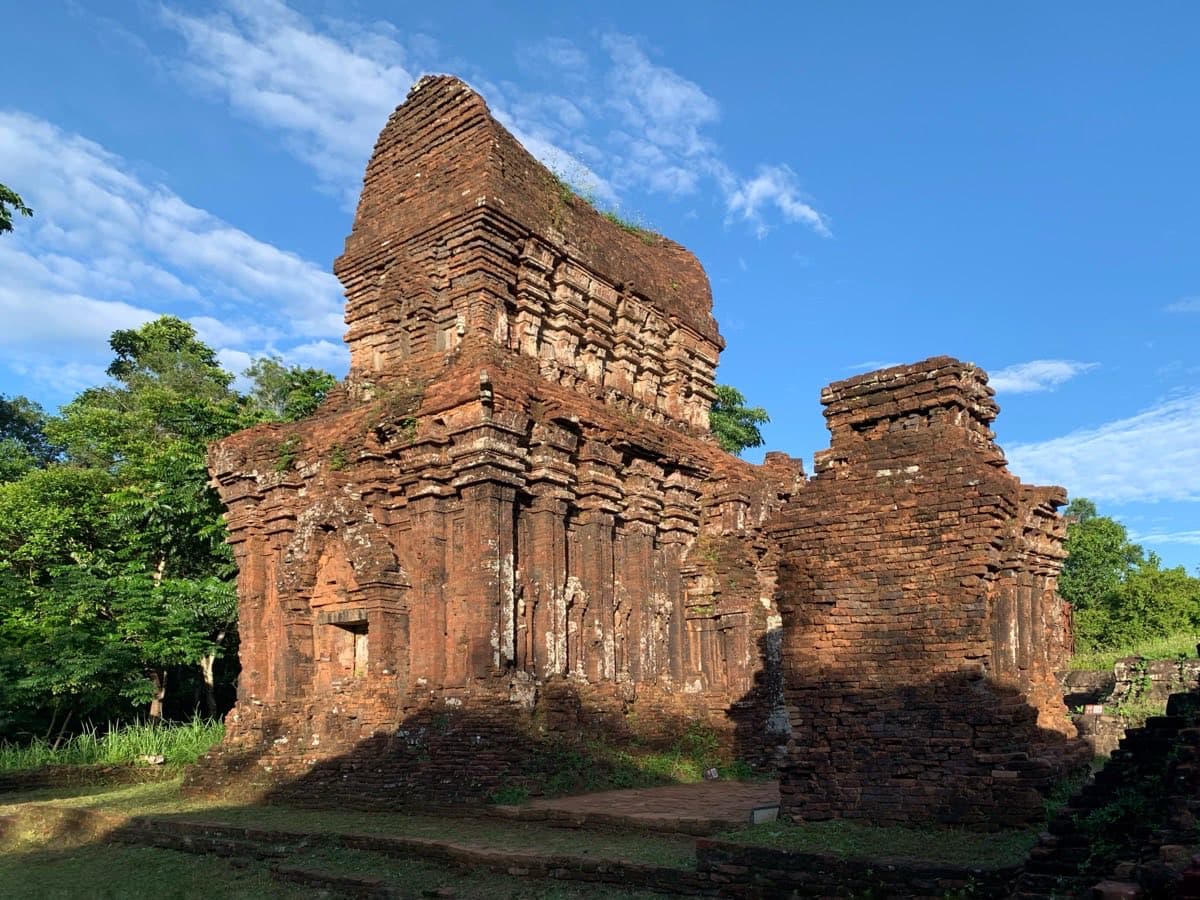
The Champa Kingdom (Champa) existed from the 2nd to the 17th century across central and southern Vietnam. The Cham were seafarers and traders whose ports linked China, India, Arabia and the islands of the Malay Archipelago. Their religion, architecture and writing all came from India.
4th century. King Bhadravarman built the first wooden temple in the My Son valley and dedicated it to Shiva. The site was no accident: the valley is ringed by mountains, cooler than the plains, with a river carrying clean water.
535–536. The temple burned down in a fire. But by the end of the 6th century King Sambhuvarman had rebuilt the complex — this time in brick. What holds the bricks together is still not fully understood.
7th–13th centuries. The golden age. My Son became the religious capital of Champa. About 70 structures — one of the foremost Shaiva temple complexes in Southeast Asia. Each new king built his own temple, trying to outdo his predecessor.
15th–17th centuries. Champa weakened under pressure from the Vietnamese from the north. The temples were abandoned and the jungle swallowed them.
19th century. French explorers "rediscovered" My Son. The first excavations began.
1969. American bombing destroyed part of the complex. Group A's main tower, A1, was reduced to a pile of brick. What survives is a small miracle.
1999. UNESCO inscribed My Son on the World Heritage List as evidence of a vanished Asian civilisation — Champa.
Architecture and temple groups

The structures are split into groups; the main ones are labelled A, A’, B–H and K. Each group is a self-contained "mini-temple" with its own towers, altars and outbuildings.
What to see
Group B–C–D is the best-preserved cluster. The central tower of Group B is the tallest and most impressive of the survivors, with bas-reliefs of Shiva, elephants and mythical creatures. Group D is a long hall thought to have been a space for meditation.
Group A was once the grandest of all. Its main tower, A1, was destroyed in the 1969 bombing — today only a crater and rubble remain, with a memorial plaque.
Repeated visits reveal large, bowl-shaped craters hidden beneath dense foliage throughout the site… one crater that is nearly as deep as a man is tall, now partly covered by the roots of old treesBao Anh and Tran Mai, Tuoi Tre News, 2025
Groups E–F are less intact, but you can still make out temple foundations, bas-reliefs and fragments of sculpture. Fewer tourists come here, so you can have the place to yourself.
Groups G–H are the farthest out and take a walk through the jungle to reach. For those who want the full immersion.
Architectural features
- What binds the bricks. The great riddle of My Son. One theory is plant resin, another a binder made of the same clay. Chemical analyses lean towards the second.
- The kalan (tower). A tapering form, a symbol of Mount Meru. The entrance always faces east, towards the rising sun.
- Lingam and yoni. The main altar is a Shiva lingam set on a yoni (the symbol of the feminine). Together they stand for creation.
- Bas-reliefs. Dancing apsaras, elephants, lions, makara (mythical sea creatures). Indian influence, but with a distinctly Cham styling.
Fast Track — no queue at the border
5–10 minutes instead of an hour in the immigration queue
from$11per passenger
Getting there from Hoi An and Da Nang

It is 40 km, about an hour by car, through rice fields and villages. From Da Nang it is around 70 km (1.5 hours), so most travellers base themselves in Hoi An. More on getting around Hoi An.
| Option | Price | Time | Pros | Cons |
|---|---|---|---|---|
| Group tour | $15–20 | 4–5 h (half day) | English guide, transfer, often a boat ride back | Only ~1.5 h on site |
| Private car | $40–50 return | 1 h each way | Air-con, your own pace, driver waits | Pricier, no guide |
| Taxi / Grab | ~300,000 VND (~$12) one way | 1 h | Your own pace | Harder to find a ride back |
| Scooter | Fuel only (rental ~$5–7/day) | 1 h | Freedom, scenic ride | Hot, no air-con |
Tickets, opening hours and what to bring
Tickets
Entry: 150,000 VND (~$6). The ticket already covers the electric buggy from the car park to the temples (1.5 km) and the dance show, so nothing else needs paying inside. Buy it at the gate or online at mysonticketonline.vn; bring some cash for the gate just in case. Queues are rare, and My Son is far quieter than Hoi An's Old Town.
Opening hours
06:00–17:00 daily.
What to bring
- Water (at least 1 litre — there is little shade on site)
- A hat and sunscreen
- Closed shoes (stones, roots, uneven ground)
- Insect repellent
- A camera (photos allowed everywhere)
5 tips for visiting
- Arrive for the 06:00 opening. Mornings are cooler, the crowds aren't in yet and the light is soft — the best time for photos
- Don't miss the dance show (five times a day in the performance hall, included in your ticket) — living Champa art
- Start with the far groups (E–G) and work back to B–C–D — that way you dodge the tour buses
- Get an audio guide or read up on the history first — without context the brick walls don't say much
- Plan for 2.5–3 hours — the buggy plus walking, the ruins and the show


The Cham dance show

Every day the complex puts on a performance of the traditional dances of the Champa Kingdom, and it is already covered by your ticket. Musicians play drums and gongs while dancers in bright costumes perform the ritual dances — the very ones carved onto the temple bas-reliefs.
Schedule in the performance hall: 09:45, 10:30, 11:15, 14:00 and 16:00. There is also a show by Group G at 9:00 and 14:45. Times get adjusted now and then; check the My Son management board's site.
This is no box-ticking tourist show but a genuine effort to keep Cham culture alive. The programme is staged by the My Son heritage management board.
My Son vs Angkor Wat
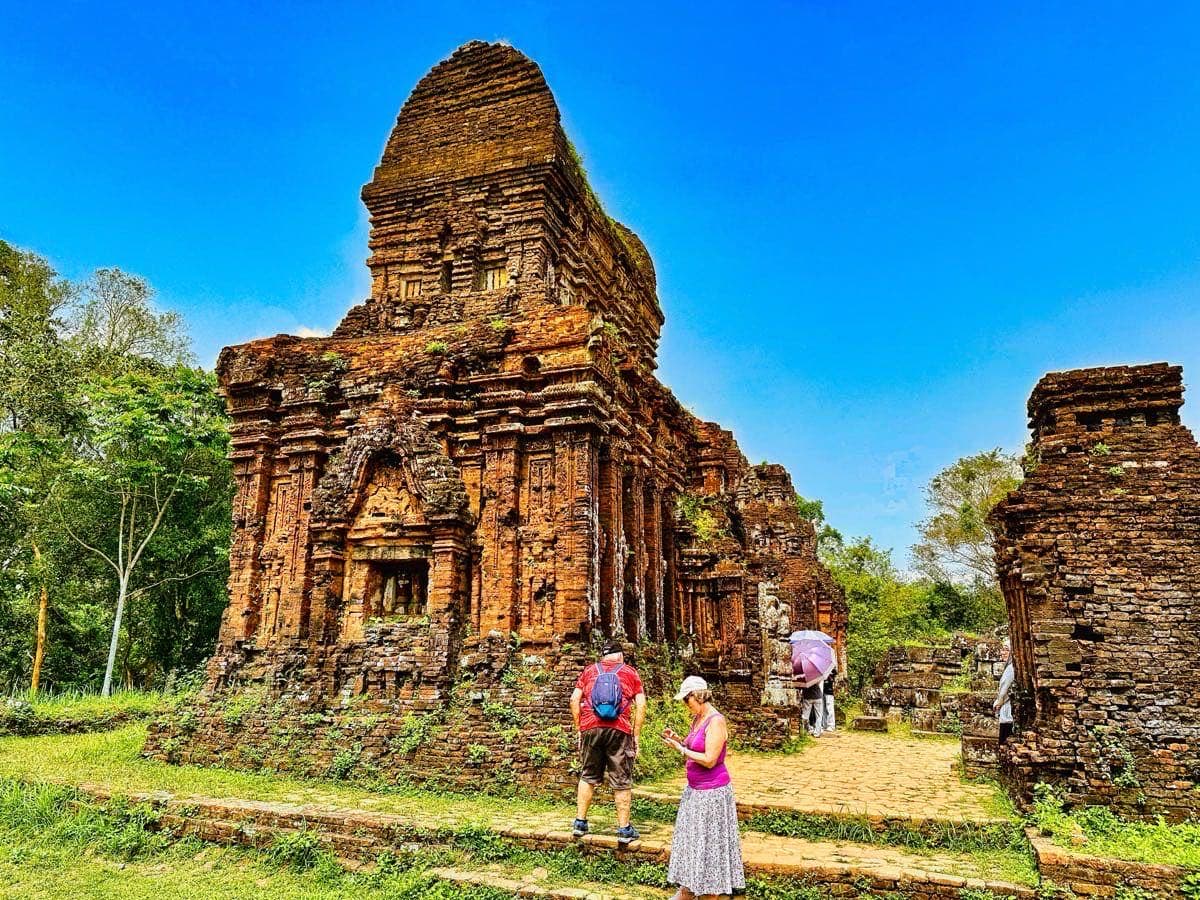
The comparison is inevitable and unfair. Angkor Wat is dozens of times larger. But My Son has its own aces.
| Criterion | My Son | Angkor Wat |
|---|---|---|
| Age | 4th–13th c. | 9th–12th c. |
| Religion | Hinduism | Hinduism → Buddhism |
| Scale | ~20 surviving structures | Hundreds of temples |
| Tourists | Few | Crowds |
| Entry price | ~$6 | $37 a day |
| Atmosphere | Intimate, in the jungle | Monumental |
| Time needed | 2–3 hours | 3–5 days |
My Son is for those who value atmosphere over scale. You can stand alone among ancient temples in the jungle — something that no longer happens at Angkor.
For more, see all of Hoi An's attractions. If you want to combine it with the coast, Da Nang makes an easy base — see our Da Nang guide and its day trips and tours.
FAQ — common questions about My Son Sanctuary
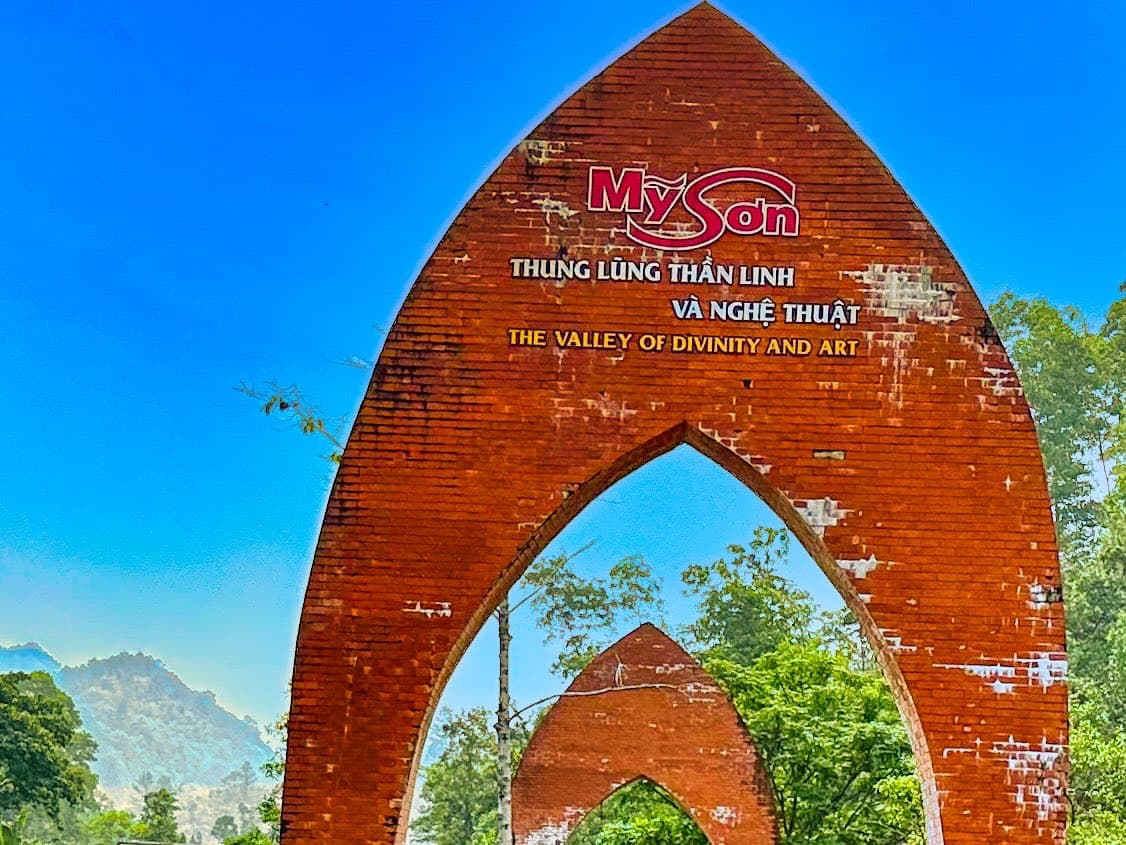
150,000 VND (~$6). The price already covers the electric buggy from the car park to the temples and the dance show, so there are no extra charges inside. Tickets are also sold online at mysonticketonline.vn; bring some cash for the gate just in case.
At least 2.5 hours on site, plus an hour each way from Hoi An. Most group tours only give you about 1.5 hours, which is tight if you want to reach the far groups and catch the dance show.
A group tour ($15–20 with transfer and guide) is easiest and cheapest, but only gives you about 1.5 hours on site. A private car ($40–50 return) or a Grab (~$12 one way) costs more but lets you set your own pace. A scooter is the cheapest and most scenic option, though it is hot. English-language sunrise tours are easy to book from Hoi An and Da Nang.
Early morning, for the 06:00 opening. It is cooler, quieter and the light is best for photos. The tour buses roll in around 09:00 and it gets busy. The best months are February to April.
Yes. It is a different experience: intimate, quiet, without the crowds. My Son is about atmosphere and history rather than scale. And it has the Cham dance show, which you won't find in Cambodia.
Sort of. Kids over 10 will appreciate it, especially with some backstory. Younger children may find it hot and dull. There is no kids infrastructure and a lot of walking over uneven ground.
- Guide
Hoi An Beaches 2026: An Bang, Cua Dai & Islands
Hoi An beaches guide: An Bang and Cua Dai, quiet Ha My, the Cham Islands, cycling from the Old Town, season, safety and where to stay.Hoi An Beaches 2026: An Bang, Cua Dai & Islands - Guide
Things to Do in Hoi An at Night: Shows, Bars & Lanterns
What to do in Hoi An after sightseeing: the Memories show, VinWonders, the night market, riverside bars, lantern boats and family picks.Things to Do in Hoi An at Night: Shows, Bars & Lanterns - Guide
Hoi An Workshops: Tailoring, Lanterns & Cooking Classes
Hands-on Hoi An: get clothes tailored, make a lantern, take a cooking class or try pottery at Thanh Ha — prices, where to go and what to pick.Hoi An Workshops: Tailoring, Lanterns & Cooking Classes


