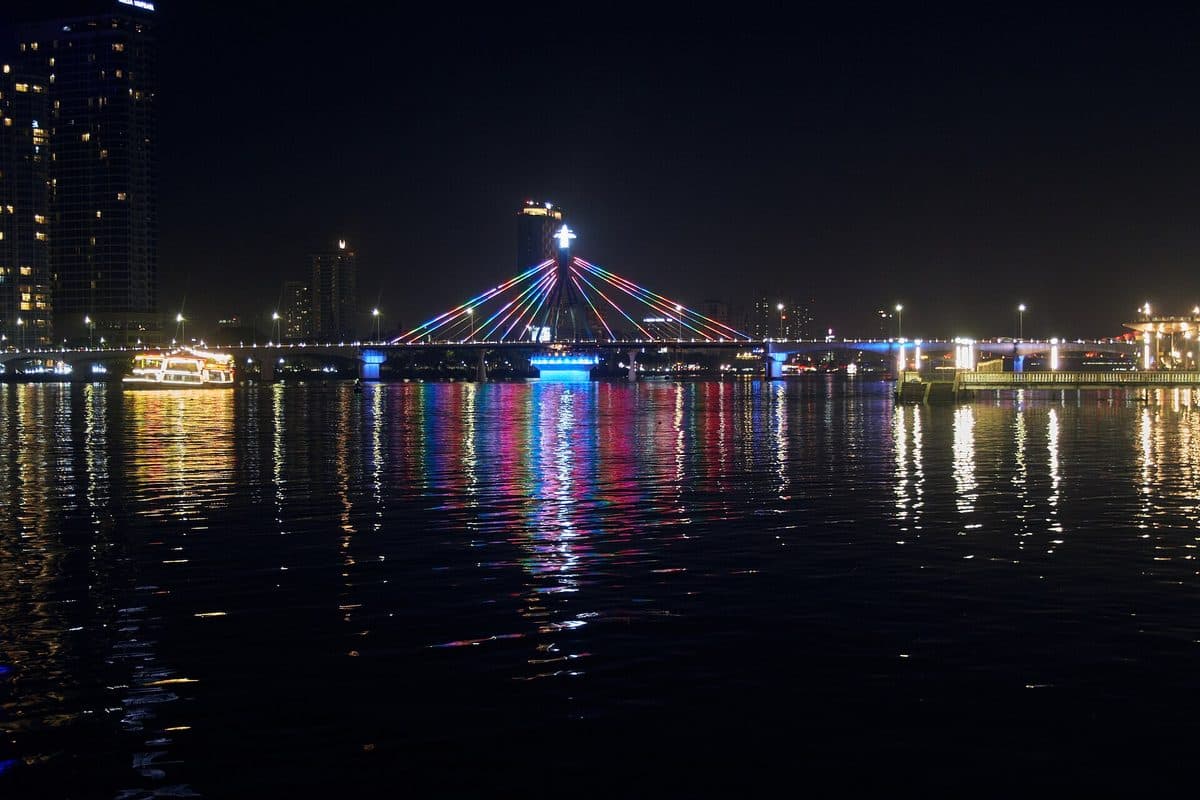
Getting around Da Nang: Grab, motorbikes and trains in 2026
The airport is ten minutes from the centre. A GrabBike across town is about 40,000 VND (~$1.50). The bus to Hoi An is 30,000 VND (~$1.15), and the train to Hue over the Hai Van Pass starts at 90,000 VND (~$3.50). Da Nang is more compact than most Vietnamese cities, so you can genuinely skip renting a bike if you mix the apps right. Below: every way to get around town and out on a day trip, with 2026 prices.

Getting around Da Nang is simpler than Ho Chi Minh City or Hanoi. There is almost no gridlock, distances are short, and the main catch is that buses run rarely and stop early. The playbook: Grab for short hops, a motorbike for freedom, and Bus 02 for Hoi An. Below are all the options — around town and out on day trips to Hoi An, Hue and Ba Na Hills — with prices in VND and a rough USD conversion (~26,000 VND = $1), current as of July 2026.
Planning the trip itself? Start with the full Da Nang guide for the big picture on districts and neighbourhoods, and the prices guide for what a day costs. How you actually fly in — airport, hubs, domestic routes — lives in the flights article; this one is purely about getting around once you have landed.
- Da Nang Airport (Sân bay quốc tế Đà Nẵng): 3 km from the centre — Grab or taxi 10 min
- Train station (Ga Đà Nẵng): Trains to Hue from 90,000 VND (~$3.60)
- Bus station (Bến xe khách Đà Nẵng): Intercity buses — Bus 02 to Hoi An
- Marble Mountains (Ngũ Hành Sơn): 9 km from the centre — Bus 8,000 VND, paid entry
- Ba Na Hills (Bà Nà Hills): 25 km from Da Nang — Shuttle 130–170,000 VND
- Hoi An (Hội An): 30 km from Da Nang — Bus 02 — 30,000 VND, 1.5 h
Fast Track — no queue at the border
5–10 minutes instead of an hour in the immigration queue
from$11per passenger
From the airport to the city centre

Da Nang International Airport (Sân bay quốc tế Đà Nẵng, code DAD) sits just 3 km from the centre — one of the closest airports to a city centre in Vietnam. Wheels-down to a hotel on My Khe Beach is about 10 minutes and at most 70,000 VND on Grab, so a pre-booked transfer is rarely worth it: the ride is too short to pay a premium for.
Currency converter
| Option | Cost | Time | When to pick it |
|---|---|---|---|
| Grab | 50,000–70,000 VND (~$2–2.70) + 30,000 VND fee | 10 min | Cheaper than taxi, fixed price |
| Metered taxi (Vinasun / Mai Linh) | 80,000–130,000 VND (~$3–5) | 10 min | Luggage, a group, late at night |
| Xanh SM | 50,000–80,000 VND (~$2–3) | 10 min | Electric, quiet ride |
| GrabBike | 30,000–50,000 VND (~$1.15–2) | 10 min | No luggage, solo |
| City bus | 8,000 VND (~$0.30) on route 12, 15,000 VND (~$0.60) on route 06 | 20–30 min | Routes 06 and 12, until 19:25 |
06BusPhương Trang Futabuslines
- Da Nang airportCảng hàng không quốc tế Đà Nẵng
- Dragon BridgeCầu Rồng
- My Khe beachVõ Nguyên Giáp
- Vietnam-Korea UniversityĐại học Việt Hàn
21.3 km48 trips a day
- Timetable
- Every 30–60 minFrom the airport05:45–19:25From the university05:30–19:00
- Fare
- Up to 10.65 km15,000 VNDBeyond that — full route22,000 VNDSchool and university students8,000 VNDFree for children under 6 and several benefit categories
Official source — Da Nang public transport portal · Checked on Sep 18, 2026
12BusPhương Trang Futabuslines
- Xuan Dieu bus stopTrạm xe buýt Xuân Diệu
- Da Nang airportCảng hàng không quốc tế Đà Nẵng
- Pham Hung bus stopTrạm xe buýt Phạm Hùng
16.5 km
- Timetable
- Every 30 min, every 10 min at peakWhole route05:30–19:00
- Fare
- 8,000 VND
Calls at both the international and domestic terminals, though neither end of the route is the airport
Official source — Da Nang public transport portal · Checked on Sep 18, 2026
The Grab pickup zone is separate from the taxi rank. In the international terminal look for Lane 1 or Lane 2 outside; in the domestic terminal it is near Food & Drinks, around pillars 2–3. Arriving at night you have two options — a taxi at the rank or a Grab. The last bus out of the airport is route 06 at 19:25.
Da Nang airport has two terminals: Terminal 1 for domestic flights, Terminal 2 for international. They are a 5-minute walk apart. If someone is meeting you, confirm the terminal number. Taxis and Grab work at both exits, but the pickup points differ.
Skip the currency counters inside — the rate is poor. Just draw 500,000 VND from an ATM by the exit (Vietcombank or BIDV give a fair rate for foreign cards) and go. Do your main exchange in town.
Grab and Xanh SM — two apps instead of ten

Grab is the Vietnamese Uber, and then some. One app hails a motorbike, a car and food delivery. The whole app runs in English: you set the pin, see a fixed price up front, and pay by linked card or cash. It is the single most useful thing to install before you land.
| Service | Price (5 km) | Who it suits |
|---|---|---|
| GrabBike | 20,000–35,000 VND (~$0.80–1.40) | Solo, no luggage, fast |
| GrabCar | 60,000–90,000 VND (~$2.40–3.60) | Couple, air-conditioned |
| GrabCar Plus | from 100,000 VND (~$4) | Comfort, newer car |
How to use Grab in Da Nang: download the app (free on the App Store or Google Play), sign up with a phone number, add a Visa/Mastercard or choose cash. Drop the pin, see the price, confirm — a driver usually arrives in 3–7 minutes. There is an in-app chat with auto-translation, handy when your driver does not speak English.
Xanh SM is an electric taxi service running VinFast cars. The cars are silent, zero-emission and clean, with USB charging, and drivers get separate training. It has its own app (iOS and Android) and prices are on par with Grab, sometimes a little cheaper, though the wait can run longer at peak times. The practical move is to keep both apps and compare before you ride. Be is a third Vietnamese option — it works, but there are fewer drivers and longer waits.
Metered taxis — Vinasun and Mai Linh

Da Nang has two reliable taxi fleets: Vinasun (white with a green stripe) and Mai Linh (green). The meter starts automatically and there is no haggling.
| Item | Vinasun | Mai Linh |
|---|---|---|
| Flag drop (first 0.5–0.7 km) | 11,000–12,000 VND (~$0.45) | 12,000–15,000 VND (~$0.45–0.60) |
| Per km after | 14,000–17,000 VND (~$0.55–0.65) | 14,000–17,000 VND (~$0.55–0.65) |
| 7-seater | No | Yes (Toyota Innova) |
A typical 5 km ride is 70,000–100,000 VND (~$2.80–4). Since 1 January 2025 (Decree No. 158/2024/ND-CP) a taxi fare can be set by the meter, by an app or by agreement with the taxi company at its published rate, but in Da Nang the meter still works out cheaper.
When does a taxi beat Grab? When you are four people with two suitcases, or you need a car right now rather than after a 7-minute app wait. Late at night it is easier to grab one from a hotel rank than to wait for a driver in the app.
To spot a legit taxi: a logo on the door and a plate sticker on the windscreen. If the driver will not start the meter, get out. Scams are rare in Da Nang, but freelance "drivers" sometimes tout inflated fares near the airport.


City buses — DanaBus
Twenty routes, 730 stops, run by DanaBus. The buses have air-con and electronic displays. The one problem: they run rarely and stop early.
| Route type | Numbers | Fare | Frequency |
|---|---|---|---|
| Subsidised | 05, 07, 08, 11, 12 | 8,000 VND (~$0.30) | 15–30 min |
| Non-subsidised | 02, 03, 06, 09, 13, 14, 21 | 8,000–30,000 VND (~$0.30–1.20) | 20–30 min |
First departures fall between 5:15 and 5:45, last ones between 18:00 and 19:25 — each route has its own window, published in its route decision. You pay the conductor in cash, and change is often short — keep small notes handy.
Route numbers shift: some have been renamed (17 became 09, 16 became 13) and some withdrawn. Check the number before you travel — this is what a withdrawn route looks like:
10BusQuảng An 1
Route suspended
- Da Nang airportCảng hàng không quốc tế Đà Nẵng
- Tho QuangThọ Quang
10.4 km
- Fare
- 8,000 VND
The portal marks this route as suspended, so no timetable is shown: the last window in force, 05:45–18:00, no longer means anything
Official source — Da Nang public transport portal · Checked on Sep 18, 2026
For navigation, the DanaBus app (free) shows routes and live bus positions; Google Maps also knows the timetable, and the site isdanangbus.vn. Before a trip, open DanaBus, punch in your destination and it shows the route number, nearest stop and time to the next bus.
Between 2026 and 2030 the city plans five new routes, including one to the Son Tra tourist area. For now the network covers the centre and main directions, but the more distant beaches and outer districts are easier by bike or Grab.
Renting a motorbike

A bike is the most flexible way to move. Rent it in the morning and in one day you can loop the Marble Mountains, Non Nước beach and be back over the Dragon Bridge by dinner. Grab cannot do that.
| Type | Per day | Per month |
|---|---|---|
| Manual (Honda Wave, Yamaha Sirius) | 120,000–150,000 VND (~$4.60–6) | 1.5–2M VND (~$58–77) |
| Maxi-scooter (Honda PCX, Honda SH) | 300,000–400,000 VND (~$12–16) | 3–4M VND (~$120–160) |
| Electric bike | from 100,000 VND/day (~$3.85) | 1–1.5M VND (~$38–58) |
Where to rent: most shops cluster around My Khe beach — on Nguyen Van Thoai, Ha Bong and Ho Nghinh streets. Search Google Maps for "Motorbike for rent Da Nang" and message a shop on WhatsApp or Zalo to have a bike delivered to your hotel. Online platforms include BikesBooking and Localrent.
Traffic in Da Nang is calmer than in Ho Chi Minh City or Hanoi. The roads are wide, there are lane markings and drivers behave predictably. If you have riding experience, Da Nang is a good place to do it. Total beginners should practise on empty streets first, or take an electric bike — slower and easier to handle.
Helmets are mandatory; riding without one is a 400,000–600,000 VND fine. Shops usually give a helmet for free, but check it is a full-size one, not a flimsy "shell."
Petrol prices are state-regulated and change regularly (the current one is on the Petrolimex site), and Petrolimex stations are all over the city. A full tank on a Honda Wave covers 150–200 km — enough for a couple of days around town.
Da Nang to Hoi An

30 km, anywhere from 30 minutes by car to an hour and a half by bus. Hội An is the top day trip out of Da Nang — the Old Town, the lanterns, An Bang beach — and getting there is easy.
It's a very pleasant, colourful, vibrant little town, definitely worth setting aside two days for… In my opinion, it's of course better to stay overnight in Hoi An than to shuttle back and forth from Da Nang several timesАнастасия Г., Vinsky Forum, 2024, translated by VietnamSpot
| Option | Cost | Time | Upside |
|---|---|---|---|
| Bus 02 | 30,000 VND (~$1.20) | 1.5 h | Cheap, every 15–30 min |
| Grab (car) | 250,000–400,000 VND (~$10–16) | 30–40 min | Fast, door to door |
| Tourist shuttle | 100,000–150,000 VND (~$4–6) | 40–50 min | Comfortable, air-con |
| Motorbike | ~50,000 VND fuel (~$2) | 30–40 min | Freedom, scenic road |
| Private transfer | from 400,000 VND (~$16) | 30 min | Easy with family, book ahead |
02BusPhương Trang Futabuslines
- Da Nang central bus stationBến xe Trung tâm Đà Nẵng
- Da Nang city centreTrung tâm hành chính
- Con Ga cathedralNhà thờ Con Gà
- Hoi An, Cua Dai pierBãi đỗ xe Bến thủy nội địa Cửa Đại
46.7 km60 trips a day
- Timetable
- Every 15–30 minWhole route05:15–18:30
- Journey
- 90 min
- Fare
- Up to 10 km8,000 VND10–25 km20,000 VNDBeyond that — full route30,000 VNDSchool and university students pay 8,000 VND for any distance
The city centre to Cua Dai leg takes 70 of the 90 minutes — boarding at the bus station is noticeably longer
Official source — Da Nang public transport portal · Checked on Sep 18, 2026
LK02BusPhương Trang Futabuslines
- Vietnam-Korea UniversityTrạm xe buýt Đại học Việt Hàn
- Hoi An, Cua Dai pierBãi đỗ xe Bến thủy nội địa Cửa Đại
23.2 km72 trips a day
- Timetable
- Every 15–30 minFrom the university06:05–19:05From Cua Dai05:00–18:00
- Fare
- Up to 11.6 km8,000 VNDBeyond that — full route15,000 VND
Official source — Da Nang public transport portal · Checked on Sep 18, 2026
01SBShuttleHải Vân (Quảng Nam)
- Da Nang airportCảng hàng không quốc tế Đà Nẵng
- Hoi An, Cua Dai pierBến tàu Cửa Đại
45 km
- Timetable
- The operator publishes no timetable. Departures follow the flight schedule, so the operator publishes no times. Ask at the arrivals hall desk
- Fare
- 120,000 VNDVeterans, disabled passengers and children under 6 pay half
Ten-seat Hyundai Solati minibuses, three vehicles in total — seats can run out at peak times
Official source — Da Nang public transport portal · Checked on Sep 18, 2026
Bus 02 is the best budget option. It leaves from Da Nang central bus station (Bến xe Trung tâm) and terminates at the Cua Dai pier car park. Pay the conductor in cash — the fare is banded and the full route costs 30,000 VND. Last departure is 18:30, so don't miss it.
You don't have to board at the bus station — the route crosses the whole city with stops on the main streets. DanaBus and Google Maps show every intermediate stop, so you can catch it from My Khe too; just find the nearest stop in the app.
By bike the road is a treat in itself. You ride along the coast past beaches, rice paddies and fishing villages. Take the coastal Trường Sa road rather than the expressway — it is about 40 minutes, but you will want to stop at every bend.
Want to head back to Da Nang in the evening after the last bus has gone? Grab works from Hoi An, but there are fewer cars and a 10–15 minute wait. Or just stay the night — Hoi An has plenty of places from around 300,000 VND (~$12) a night.
Da Nang to Hue

95 km over the Hải Vân Pass — one of the most beautiful mountain roads in Southeast Asia. Or 2 hours 48 minutes on the train, hugging the coast the whole way.
| Option | Cost | Time | Upside |
|---|---|---|---|
| Train | 90,000–250,000 VND (~$3.60–10) | 2h 48m | Comfy, scenic, no traffic |
| Bus LK01 | 80,000 VND (~$3) | 2.5–3 h | Cheap |
| Grab / taxi | from 1,200,000 VND (~$48) | 1.5–2 h | Handy for a group |
| Motorbike | ~100,000 VND fuel (~$4) | 2–2.5 h | The pass is a must-ride |
The train is the sweet spot for most people. It leaves from Ga Đà Nẵng station in the city centre. Operators are Vietnam Railways and Lotus Train. Check times and fares by class (seats and sleepers) on the Vietnam Railways site. Book on 12go.asia or at the station counter.
Riding the Hai Van Pass yourself is a proper adventure. The switchbacks climb to 500 metres with ocean on one side and mountains on the other — in Top Gear's 2008 Vietnam Special, Jeremy Clarkson called it one of the best coast roads in the world. The tarmac is good, but you need riding experience and you should never set off in the rain: visibility drops to nothing and the bends are sharp.
The route in short: leave Da Nang north on the QL1A; after 20 km the climb begins. At the top are a viewpoint and an old French fort; the descent drops to the town of Lang Co and its lovely lagoon, then it is highway to Hue. Budget 3–4 hours with photo stops.
Not keen to risk the bike? Buses cross the pass too, though most take the 6.3 km Hai Van Tunnel instead — faster, but no views.
We got there on a minibus with 4 stops at very beautiful places: Marble Mountains, the Hai Van Pass, the Blue Lagoon… We left at 8 a.m. and arrived at about 2 p.m.i5808300, Vinsky Forum, 2018, translated by VietnamSpot
If you are lining up a day out to Hue, it is one of the best trips from Da Nang: catch a morning train and come back on an evening one.
Getting to Ba Na Hills and the Golden Bridge

Bà Nà Hills is 25 km from Da Nang up in the mountains, the last stretch a switchback climb: the Golden Bridge (yes, the "Hands of God" one from Instagram), a French village and a cable car. You can get there on your own, with a few caveats.
| Option | Cost | Time | When to pick it |
|---|---|---|---|
| Shuttle bus | 130,000–170,000 VND (~$5.20–7) return | 45–60 min | Budget, organised |
| Grab / taxi | 300,000–400,000 VND (~$12–15) one way | 40–45 min | Flexible timing |
| Private transfer | from 650,000 VND (~$26) return | 45 min | With family, no hassle |
| Organised tour | 1,200,000–2,000,000 VND (~$48–80) | Full day | All-inclusive |
| Motorbike | ~50,000 VND fuel (~$2) | 45–60 min | Experienced riders only, mountain switchbacks |
Shuttles leave central Da Nang around 7:30–8:00 and head back 15:30–16:00. Book through a tour desk or Klook.
The cable car is part of the Sun World ticket, which covers the ride up, the ride down and access to the main attractions. Quoted prices vary, so check the current one on the Sun World site before you go.
By bike the road is interesting: the first stretch is ordinary highway, then the mountain switchbacks begin. The tarmac is good but the corners are tight, and on a cloudy day visibility drops. Fine for experienced riders; if you only got on a bike last week, take the shuttle.
The whole Ba Na Hills complex takes 4–6 hours to see. Leave Da Nang no later than 8:00.
Getting to the Marble Mountains
Ngũ Hành Sơn (the Marble Mountains) is just 9 km from central Da Nang: five limestone hills with pagodas, caves and city views. It is the easiest of the lot to reach.
| Option | Cost | Time |
|---|---|---|
| Bus 02 | 8,000 VND (~$0.30) | 20–30 min |
| Grab | 40,000–60,000 VND (~$1.60–2.40) | 15 min |
| Motorbike | ~10,000 VND fuel (~$0.40) | 15 min |
Entry to the Marble Mountains and the lift up are paid separately at the gates; check prices on the spot. Start at Gate 2 — the climb is easier from there and the lift is nearby.
On the bus, get off at the Non Nuoc stop. Tell the conductor "Ngũ Hành Sơn" and they will understand. For the way back, a Grab is 2–3 minutes away with a stand right at the entrance.
Next to the mountains are a stone-carving village and Non Nuoc beach. On a bike you can do the caves, a swim and be back in half a day. Check the local weather first — in the rainy season (October–December) the climb gets slippery.
Common mistakes and what to know
Da Nang is mellower than Ho Chi Minh City or Hanoi, but a couple of things still catch people out.
Fake taxis. Freelance "drivers" with no markings may approach you at the airport exit, and the fare comes out 3–4x higher. Head to the official taxi rank or order a Grab.
Buses give no change. The conductor won't break big notes. 5,000 and 10,000 VND notes are what you want; don't board with a 500,000.
Riding without a licence. Da Nang police check for an IDP on the road, and under Decree 168/2024 the fine starts at 2 million VND, or 6 million on a bike over 125cc. If your home licence has no motorcycle (A) category, don't rent a bike.
Grab at the airport. The Grab pickup zone is not at the taxi rank. International terminal: Lanes 1–2 outside. Can't find it? Ask staff, "Where is the Grab pick-up?"
Crossing the road. The classic Vietnam move: walk slowly and steadily, don't stop, don't run. The motorbikes will flow around you. It sounds insane, but it works.
The last bus. DanaBus routes finish between 18:00 and 19:30, each with its own window. Plan for it if you have gone far from the centre.
Bike insurance. Rentals do not include insurance. Fall off and the repair and any treatment are on you. Standard travel insurance with motorbike cover — and it usually only pays out if you hold a valid IDP — is worth having; a scratch on someone else's bike can run 3–5M VND (~$120–200).
Parking. Bike parking is 5,000–10,000 VND. Malls and the main sights have guarded lots: you hand over the bike, get a tag, and show it plus the fee on the way out. Don't lose the tag — no tag, no bike.
Fuel. Petrolimex stations have green signs with a red logo. The price of A95 is shown on the pump. Some pumps are self-service, but usually an attendant fills up — say "đầy bình" (full tank) or point to the amount.
Handy Vietnamese phrases for getting around
| Phrase | Vietnamese | Roughly |
|---|---|---|
| How much? | Bao nhiêu tiền? | bow nyew tien? |
| Full tank | Đầy bình | day binh |
| Stop here | Dừng ở đây | zung uh day |
| Let's go! | Đi thôi! | dee thoy! |
| Right / left | Rẽ phải / Rẽ trái | zeh fai / zeh chai |
FAQ
- A GrabCar50,000–70,000 VND~$2–2.70runs, plus a 30,000 VND airport pickup fee paid in cash to the driver
- A GrabBike with no luggage30,000–50,000 VND
- Surge pricing in rain or in the eveningabout 1.5xpushes the fare up
Yes. You need an International Driving Permit (IDP) under the 1968 Vienna Convention with the motorcycle (A) category, plus a valid home licence covering motorcycles. Da Nang police check regularly. Under Decree 168/2024 (in force since 2025) riding without a licence costs 2–4 million VND on a bike up to 125cc and 6–8 million VND on a bigger one. Note that US-issued IDPs are 1949-Convention and not formally recognised in Vietnam.
It is about 30 km
- The yellow Bus 0230,000 VND~$1.20is the cheapest and runs every 15–30 minutes
- A Grab car door to door in 30–40 minutes250,000–400,000 VND
- Tourist shuttles100,000–150,000 VND
- A motorbike along the coastthe most scenic option
See the full Hoi An guide for what to do once you arrive
It is 95 km over the Hai Van Pass
- The scenic train90,000–250,000 VND~$3.50–10takes about 2h48m for
- Bus LK0180,000 VND~$3goes through the tunnel rather than over the pass
- Riding the pass yourselfone of the great ridesin Southeast Asia
See the Hue guide for the imperial city itself
In-app services like Grab and Xanh SM accept Visa and Mastercard linked to your account. Street-hailed metered taxis (Vinasun, Mai Linh) are cash-first — keep small VND notes. ATMs at Vietcombank or BIDV give fair rates for foreign cards.
No. Uber left Vietnam in 2018 after selling its business to Grab. Use Grab, Xanh SM (electric) or Be instead — all of them work in English.
My Khe Beach is only 2–3 km from the centre. A GrabBike is 15,000–25,000 VND (~$0.60–1) and takes about 5 minutes. If you are staying near the Dragon Bridge you can walk it in roughly 15 minutes.
The easiest place is 12go.asia — schedules, prices and online booking in English. You can also buy at the counter of Ga Đà Nẵng station (open 6:00–22:00). Vietnam Railways and Lotus Train run to Hue, Hanoi, Nha Trang and Ho Chi Minh City.
- Guide
Things to Do in Da Nang: Fun, Shows & Nightlife 2026
What to do in Da Nang: Sun World, the Dragon Bridge fire show, beach clubs, rooftops, day trips and family-friendly picks — with prices and tips.Things to Do in Da Nang: Fun, Shows & Nightlife 2026 - Guide
Da Nang Fireworks Festival: 2026 Recap and 2027 Plan
Portugal won DIFF 2026. Real grandstand prices, 10 free viewing spots on the Han River, how to get out after the show, and when DIFF 2027 gets announced.Da Nang Fireworks Festival: 2026 Recap and 2027 Plan - Guide
Hai Van Pass: How to Cross Vietnam's Best Coast Road
The Hai Van Pass between Da Nang and Hue: motorbike, easy-rider, car or the heritage train — how to cross, what to see and the best time to go.Hai Van Pass: How to Cross Vietnam's Best Coast Road