Things to do in Con Dao in 2026
Con Dao is 16 islands, the main one still covered in jungle: a prison that held political prisoners for 113 years, coral reefs with 30-metre visibility, green turtles nesting on the sand under a full moon — and not a single shopping mall on the whole archipelago. Here is what to see, with prices, seasons and the honest downsides.

Côn Đảo is an archipelago 250 km from Ho Chi Minh City. People fly here for what Phu Quoc and Nha Trang lost long ago: quiet and clean water. Tourist numbers are still low, the infrastructure is modest, and entry tickets start at just 40,000 VND (~$1.60).
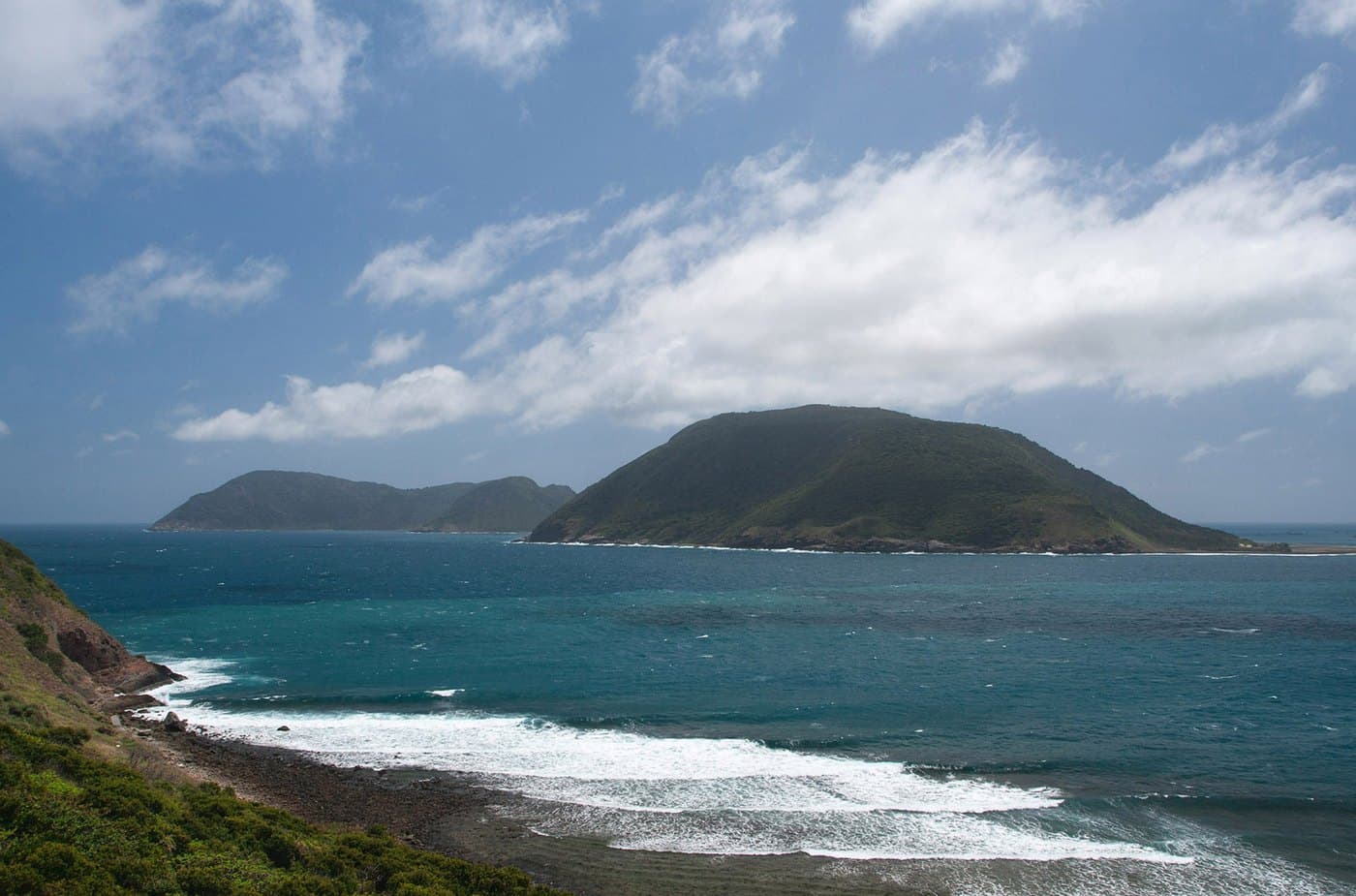
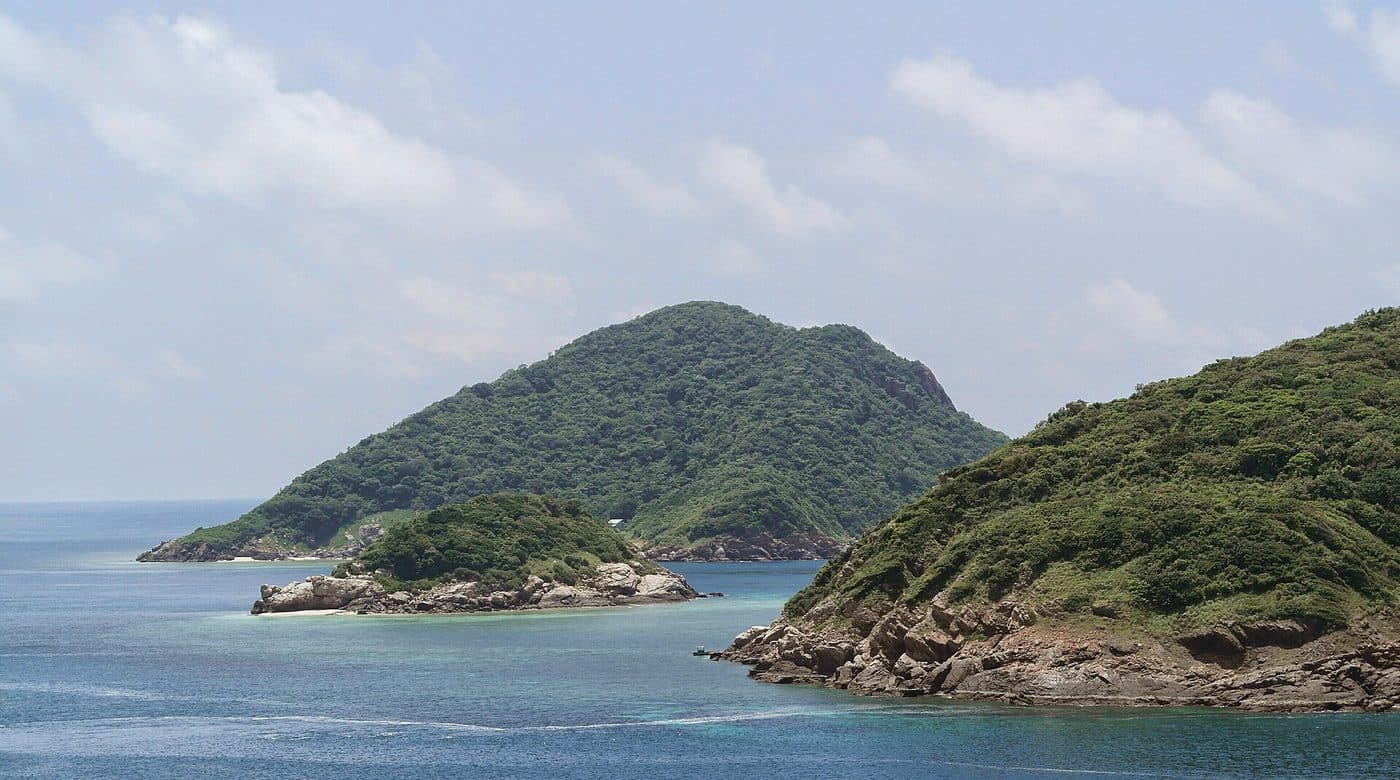
The main island is Côn Sơn. It has the airport, a small town with hotels and restaurants, and all the on-land sights. The other 15 islands are uninhabited — you reach them by boat.
Below are the places worth 3–5 days on Con Dao: prices, coordinates, seasons and honest downsides. If you want the bigger picture — transport, where to stay, neighbourhoods — see the full Con Dao guide.
- Phú Hải Prison (Trại Phú Hải): Main prison compound — about 40,000 VND (~$1.60), 07:30–11:30 & 14:00–17:00
- Tiger Cages (Chuồng Cọp): 120 French cells, 384 American
- Hàng Dương Cemetery (Nghĩa trang Hàng Dương): About 20 ha, 1,913 graves — Grave of Võ Thị Sáu
- Con Dao Museum (Bảo tàng Côn Đảo): Island history — Prison artefacts
- National Park office (VQG Côn Đảo): Permit 50,000–60,000 VND (~$2–2.40)
- Đầm Trầu Beach (Bãi Đầm Trầu): Best beach — 14 km from town, white sand
- Nhát Beach (Bãi Nhát): Vanishes at high tide — Best sunsets
- An Hải Beach (Bãi An Hải): Town beach — Basic facilities
- Ông Đụng Beach (Bãi Ông Đụng): 1-hour hike — Snorkelling from shore
- Đất Dốc Beach (Bãi Đất Dốc): Six Senses resort beach
- Bảy Cạnh Island (Hòn Bảy Cạnh): Turtles, snorkelling, lighthouse — Boat 30–45 min
- Đầm Tre (Đầm Tre): Bamboo Lagoon — Snorkelling, 2-hour hike
Con Dao Prison — 113 years on the islands of horror

The Côn Đảo prison is the archipelago's main sight and one of the most sobering places in Vietnam. Over 113 years (1862–1975) tens of thousands of political prisoners passed through it, and around 20,000 died here. A single ticket covering every site is about 40,000 VND (~$1.60); check the price at the booth.
The prison consistently ranks first among Con Dao attractions on Tripadvisor. Everyone comes: Vietnamese visitors, for whom it is a place of remembrance, and foreign travellers, who tend to leave silent.
The Phú Hải prison complex
The French built the first camp, Trại Phú Hải, in 1862 — two years after taking Saigon. A prison on a remote island was ideal for isolation: nowhere to run, sea on every side. Other camps followed, among them Phú Tường and Phú Bình. Each was its own world of barracks, punishment cells and yards for forced labour.
Phú Hải is the largest. Long rows of cells, dark corridors, shackles bolted to the floor. Photographs of prisoners line the walls, and some cells are preserved as they were found at liberation.
All the prisons are very similar to one another, it's enough to visit any one of them.Oleg Gabdraupov, Vinsky Forum, 2020, translated by VietnamSpot
You buy the ticket at the booth by the governor's palace. It gives access to the prison complexes, the museum and the palace. Hours are 07:30–11:30 and 14:00–17:00 daily; confirm on site. The lunch break is strict — don't try to get in between 11:30 and 14:00, the gates are shut.
The Tiger Cages — the grimmest part
Two camps hold the "Tiger Cages": the French ones (Chuồng Cọp Pháp) in Phú Tường and the American ones in Phú Bình. The French camp has 120 cells and the American one 384, all with bars for a ceiling. Guards walked the upper level and could beat prisoners with poles or drop quicklime through the bars.
The cells are so cramped you cannot stand upright. In the heat, temperatures inside reached 40–45°C. Prisoners went months without fresh air.
The Tiger Cages came to light in July 1970. A US congressional delegation — Representatives Augustus Hawkins and William Anderson, their aide Tom Harkin and interpreter Don Luce — left the planned tour and followed a former prisoner's map to the cells. Harkin photographed the prisoners, and Life magazine ran the pictures. The scandal fed the anti-war movement.
Hàng Dương Cemetery
Nghĩa trang Hàng Dương is a memorial cemetery of about 20 ha. Its four sections hold 1,913 graves, and more than a thousand of them are unnamed.
The most revered is the grave of Võ Thị Sáu. She was 19 when she was executed on Con Dao in 1952, the youngest woman put to death in the Vietnamese resistance. Thousands of Vietnamese come every year with chrysanthemums and lotus.
A local tradition is a night pilgrimage around 3 a.m.; Vietnamese believe her spirit visits then. The cemetery is open around the clock. Even if you have no interest in the mystical, a night visit leaves an odd impression: silence, candles, the tropics.
Con Dao Museum
Bảo tàng Côn Đảo tells the archipelago's story from colonisation to liberation. The newer museum has a well-laid-out exhibition: prison artefacts, photographs, documents, models of the camps. It is covered by the single ticket, and 30–40 minutes is enough. Start here if you want the context before the prison — the cells hit twice as hard afterwards.
The national park — forest and sea under protection

Con Dao National Park (Vườn quốc gia Côn Đảo) spans 5,883 ha of island forest and 14,000 ha of sea. It became a national park in 1993, built on a protected forest set up in 1984, and it protects the ecosystem of all 16 islands.
On land, dense tropical forest. Underwater, coral reefs and the sea turtles that draw divers from around the world.
The highest point is Mount Núi Thánh Giá (577 m), with views over the whole archipelago and the open sea.
How to get a permit
Any route inside the national park needs a permit. It costs about 50,000–60,000 VND (~$2–2.40); the park does not publish the fee, so check at the booth. It is issued daily — each new day's hike means a new permit. The park ticket office is by the ferry pier, at 36 Tôn Đức Thắng.
Most trails you can walk on your own, without a guide. The exception is the route to Đầm Tre (Bamboo Lagoon), where a guide is required.


Con Dao beaches — from wild to exclusive

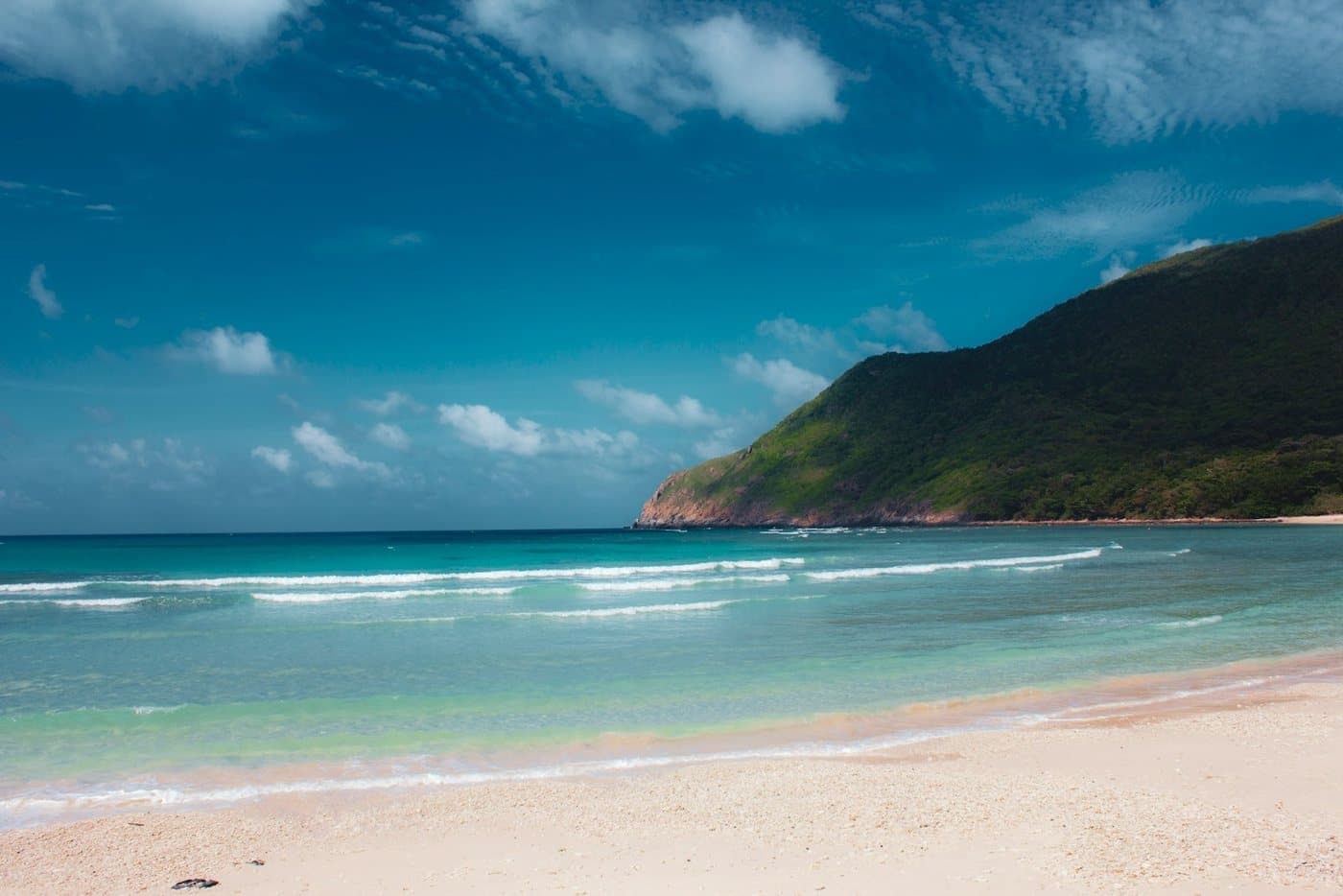
There are no crowded, lounger-packed beaches on Con Dao. Most are wild, with no facilities or just a café or two, and entry to every beach is free. After Nha Trang and Phu Quoc it feels like stepping back 20 years — to Vietnam before mass tourism.
Đầm Trầu — the best beach on the archipelago
Bãi Đầm Trầu is 14 km from Con Son town, next to the airport: white sand, dramatic rocks rising out of the turquoise water and a gentle slope into the sea. It offers the best odds of seeing green turtles while snorkelling — they feed on algae by the shoreline rocks.
Facilities are minimal: one or two cafés with coconuts and simple food (pho, seafood rice — 50,000–80,000 VND, ~$2–3.20). No umbrellas or loungers, so bring your own. The ride from Con Son by scooter is about 25 minutes along a scenic coastal road.
One quirk: the beach is briefly closed whenever planes land — the runway is right beside it. Flights are few, so it turns into entertainment: you watch a jet touch down almost overhead.
Nhát — the vanishing beach
Bãi Nhát lies 6 km south of Con Son. Its trick is the tide: at high water the beach disappears completely, and at low tide a strip of golden sand emerges among brown rocks, with crystal-clear water between the boulders like natural pools.
It is the best spot on Con Dao for sunsets — the sun drops straight behind the rocks and the scene looks like a postcard. Check a tide table before you go, or you risk finding only water.
An Hải — the town beach
Bãi An Hải is the closest to central Con Son, five minutes by scooter. It is handy for a daily swim: nip out in the morning, take a dip, be back for breakfast. There are a few cafés on the shore, loungers in the hotel zones, yellow sand, clean water and almost no waves.
Ông Đụng — the beach beyond a hike
Reaching Bãi Ông Đụng takes about an hour on foot from the national park office. The trail is paved — you cross the Ma Thiên Lãnh bridge, then 700 m through jungle with signs about the local flora. The beach itself is rocky, the water pristine, and you can snorkel straight off the rocks — coral starts about 10 metres out. Almost no one around.
The beach is rocky; going in and out of the water (especially in big waves) you need to be careful not to get hurt.Oleg Gabdraupov, Vinsky Forum, 2020, translated by VietnamSpot
You need a permit (50,000–60,000 VND, ~$2–2.40). There is no food or water at the beach, so bring your own.
Đất Dốc — the exclusive one by Six Senses
Bãi Đất Dốc belongs to Six Senses Con Dao, one of Vietnam's most expensive hotels. You can technically walk in, but without a guest wristband you will be politely turned away.
Fast Track — no queue at the border
5–10 minutes instead of an hour in the immigration queue
from$11per passenger
Diving and snorkelling — the best in Vietnam

In the dry season local dive centres report visibility of up to 30 metres — among the best in Vietnam. For comparison: Nha Trang manages 5–10 m, Phu Quoc 10–15 m. The reefs here are barely touched. Divers are few — not because it is poor, but because it is far.
The best sites
Three main spots: Hòn Tai, Hòn Bảy Cạnh and Hòn Cau. Each island has its own underwater ecosystem.
Off Hòn Tai, walls of soft coral and shoals of barracuda. At Bảy Cạnh, turtles that feed and sleep right on the reef. At Hòn Cau, rays, moray eels and bamboo sharks (small, bottom-dwelling and harmless to people).
A story of its own is Đầm Tre (Bamboo Lagoon): a lagoon in the mangroves you reach on foot via a 2-hour jungle hike (guide required). Snorkelling inside is like an aquarium — clear water, coral near the surface, fish with no fear of you.
Prices and how it works
One of the island's PADI centres is Con Dao Dive Center, running since 2013 with a team of Vietnamese and foreign instructors.
| Service | Price | Included |
|---|---|---|
| Snorkelling tour (4–5 h) | 1,000,000 VND (~$40) | Boat, gear, guide, snack |
| Diving, 2 dives | 3,600,000–4,500,000 VND (~$144–180) | Instructor, equipment, boat |
| PADI Open Water course | 12,900,000 VND (~$500) | 3–4 days of training |
Snorkelling without a tour
If you don't want to pay for an organised trip, you can snorkel on your own:
- Đầm Trầu — straight off the shore, by the rocks on the right. The coral is patchy, but fish and turtles show up
- Ông Đụng — after the hike (1 hour). Reefs start about 20 m out
- An Hải — by the rocks at the ends of the beach. Visibility is worse than at the islands, but fine for a quick snorkel
Your own mask and snorkel are a must-have. Rentals on the island are scarce and not always clean.
When to dive
The season is March–August, when the sea is calm and visibility peaks. Prime time is April–June. From September to February, waves and currents can make dives impossible and tours get cancelled. Every site with depths, PADI courses and park rules: Con Dao diving guide.
Sea turtles — the reason to stay overnight

Con Dao is Vietnam's main sea-turtle conservation site. Every year from late May to October, hundreds of green and hawksbill turtles crawl onto the beaches to lay eggs. The prime spot is Hòn Bảy Cạnh island, 30–45 minutes by boat from Con Son.
The overnight tour
The overnight tour to Bảy Cạnh is one of the more unusual experiences in Vietnam. In the afternoon you board a boat, ride 30–45 minutes across the sea and land on the island. Dinner is simple, cooked over a fire or a burner. After dark a park ranger leads the group (usually 5–10 people) to the beach — and you wait.
A turtle comes ashore in the dark. A heavy body of 100–150 kg drags slowly across the sand. She digs a pit with her back flippers, lays up to 120 eggs, and returns to the sea. The whole thing takes 2–3 hours.
Incubation lasts 45–60 days. With luck you might also see a hatchling release: rangers dig up a nest of hatched young and let them go to the water. Dozens of palm-sized turtles totter to the surf in the beam of a torch. Of 120 eggs, only 1–2 will reach adulthood.
Turtle tour prices
- Day trip (snorkel + island)850,000–1,000,000 VND ≈ $34–40
- Overnight (turtles)2,150,000–5,100,000 VND ≈ $86–204
- Hatchling release (separate tour)680,000–2,200,000 VND ≈ $27–88
Watching is only possible in season (late May to October), and only if a turtle chooses to come ashore that night. Nobody can guarantee a nesting.
Hiking — trails through the jungle
Con Dao is not only beaches and history. The island has several well-marked trails through tropical forest. Every route needs a permit from the national park office (50,000–60,000 VND, ~$2–2.40).
The trail to Ông Đụng beach
The most accessible route: about an hour each way from the park office. The trail is paved, with signs about the plants and animals of the jungle. You cross the Ma Thiên Lãnh bridge, walk 700 metres of tropical forest and come out at a wild beach.
It is ideal for a half-day: take the permit at 7:00, set off at 7:30, reach the beach by 8:30 and swim until lunch. The difficulty is minimal, fine for families with children from age 7–8.
Đầm Tre (Bamboo Lagoon)
Tougher. Two hours through dense forest and mangroves to a hidden lagoon. The trail starts near the airfield and winds through jungle — you would get lost without a guide. This is the one route on Con Dao where a guide is mandatory.
The reward is worth the sweat: a lagoon ringed by mangrove forest, clear water, snorkelling like a natural aquarium.
Mount Thánh Giá (577 m)
The archipelago's highest point. The climb takes 3–4 hours each way. From the summit, a full panorama of all 16 islands and endless sea. It is a route for the fit: steep sections, heat and 80–90% humidity. Carry at least 2 litres of water and wear hiking shoes.
When to go

You can visit Con Dao year-round, but the difference between seasons is real.
| Period | Weather | Sea | Good for |
|---|---|---|---|
| November–February | 25–28°C, dry | Calm | Beach, hiking, the prison |
| March–April | 27–30°C, little rain | Calm | Diving, beach, fewer tourists |
| May–July | 28–32°C, rain | Calm | Diving, turtles |
| August–October | 27–30°C, heavy rain | Rough | Risky: boat cancellations |
The best compromise is March–April: dry, calm sea, the diving season opening, but the summer crowds not yet arrived. If turtles are your priority, June–August — just be ready for rain.
The worst time is September–October: storms, cancelled ferries, islands closed to boats. Arriving and sitting in your hotel for three days because no boat runs is a real disappointment.
Getting to Con Dao
By plane
The main and most sensible way. From Ho Chi Minh City (SGN) to Con Dao (VCS) fly Vietnam Airlines and Vietjet Air. The line-up of carriers changes, so check the schedule. Flight time is 1 hour 15 minutes.
Fares are 1,100,000–1,800,000 VND (~$44–72) one way. Book 2–3 weeks ahead — prices climb closer to the date and seats can sell out.
Côn Sơn airport (VCS) is tiny: one terminal, one runway. It is 14 km to central Con Son, and a taxi runs 300,000–450,000 VND (~$12–18). Grab does not work here — use the Xanh SM electric taxis, the local taxi firms or electric bus 173 from the airport to the market (40,000 VND, ~$1.60).
By ferry
The Superdong ferry from Trần Đề (Can Tho, formerly Sóc Trăng province) takes 2.5 hours, with one sailing a day each way; check the current fare with the operator.
Since 6 June 2026 a direct high-speed ferry, GreenlinesDP's Phu Quy Express 02, has run from Ho Chi Minh City to Con Dao in about 5 hours 15 minutes.
The catch: you still have to reach Trần Đề from Ho Chi Minh City — a 4–5 hour bus. The plane is faster and often cheaper if you book early.
Getting around the island
A scooter is the only sensible option. Rental is 150,000 VND/day (~$6). The roads are good and traffic is a couple dozen scooters and the odd truck. You can circle the island in 2 hours. To rent, you will need a licence — an International Driving Permit is expected.
Prices and practical tips
Cost summary
| Item | Budget | Comfort |
|---|---|---|
| Flight (return) | 2,200,000 VND (~$88) | 3,600,000 VND (~$144) |
| Accommodation (per night) | 300,000–500,000 VND (~$12–20) | 1,500,000–5,000,000 VND (~$60–200) |
| Food (per day) | 200,000–300,000 VND (~$8–12) | 500,000–800,000 VND (~$20–32) |
| Prison + national park | from 100,000 VND (~$4) | from 100,000 VND (~$4) |
| Snorkelling tour | 1,000,000 VND (~$40) | 1,000,000 VND (~$40) |
| Overnight tour (turtles) | — | from 2,150,000 VND (~$86) |
| Scooter rental (per day) | 150,000 VND (~$6) | 150,000 VND (~$6) |
Over 4 days a budget traveller spends around 5,500,000 VND (~$220) excluding flights. In comfort, 12,000,000–15,000,000 VND (~$480–600).
Practical tips
Money. There are only 2–3 ATMs in Con Son, so bring cash to spare. Cards are accepted only at bigger hotels and restaurants — carry a Visa or Mastercard, and don't count on cards elsewhere.
Food. Restaurants cluster in central Con Son, along the waterfront and on Nguyễn Đức Thuận street. The seafood is as fresh as it gets: lobster from 500,000 VND (~$20), crab from 300,000 VND (~$12), grilled fish 150,000–200,000 VND (~$6–8).
Connectivity. Mobile internet covers all of Con Son — Viettel and Mobifone are stable. On the remote beaches, signal drops. A local eSIM bought before you fly saves the hassle of a SIM shop.
Where to stay. Book at least 3–4 weeks ahead. The room supply is limited — there are no big chain hotels apart from Six Senses. Budget guesthouses start at 300,000 VND/night (~$12).
What to pack
- Cash (VND) — ATMs are few
- SPF 50+ sunscreen and insect repellent
- A mask and snorkel (your own beat the rentals)
- Closed shoes for hiking
- A red-light torch (for the turtles)
- A light windbreaker (it's cool on the boat and at night)
A ready-made 3–5 day plan
3 days (minimum)
| Day | Morning | Afternoon | Evening |
|---|---|---|---|
| 1 | Museum + Phú Hải prison | Tiger Cages, governor's palace | An Hải beach, dinner on the waterfront |
| 2 | Snorkelling tour to the islands | Lunch on the boat | Đầm Trầu beach |
| 3 | Hike to Ông Đụng (1 hour) | Snorkel and relax on the beach | Sunset at Nhát, cemetery at night |
Admittedly, spending more than 4–5 days on the island felt a bit boring to me…Baypasha, Vinsky Forum, 2025, translated by VietnamSpot
5 days (comfortably)
Add to the three-day plan:
- Day 4: diving (2 dives) or a scooter loop around the island, stopping at every beach. Evening: grilled local seafood
- Day 5: the overnight tour to Bảy Cạnh (turtles) — leave in the evening, sleep on the island. Or the guided hike to Đầm Tre (Bamboo Lagoon)
FAQ
Con Dao is an archipelago of 16 islands in the South China Sea, 250 km from central Ho Chi Minh City and 83 km from the mouth of the Hau River. Since 1 July 2025 it has been a special zone within Ho Chi Minh City: Ba Ria–Vung Tau province, which used to administer the islands, was abolished. The main island, Con Son, sits at roughly 8°41′ N, 106°36′ E.
Fastest is by air: a 1 hour 15 minute flight on Vietnam Airlines or Vietjet, from about 1,100,000 VND (~$44) one way. The alternative is the Superdong ferry from Trần Đề port in Can Tho (formerly Sóc Trăng) — 2.5 hours on the water plus a 4–5 hour bus from the city. Since June 2026 there is also a direct GreenlinesDP high-speed ferry from Ho Chi Minh City, about 5 hours 15 minutes. Flying is faster and often cheaper if you book 2–3 weeks ahead.
For beaches, November–April, when it is dry and the sea is calm. For diving, March–August, with visibility up to 30 metres. For sea turtles, late May to October. Worst months are September–October: storms, rain up to 348 mm a month, and cancelled boat tours.
Day 1: the prison and Hàng Dương Cemetery (half a day), then An Hải beach. Day 2: a snorkelling tour to the islands or a dive trip. Day 3: hike to Ông Đụng beach in the morning, Đầm Trầu beach after lunch, sunset at Nhát beach.
- A budget 4-day trip (excluding flights)around 5,500,000 VND~$220runs; that covers a simple hotel, café meals, the prison and one snorkelling tour
- A comfortable trip12,000,000 VND~$480
- To15,000,000~$600
- A return flight from Ho Chi Minh Cityaround 2,200,000 VND~$88starts if you book early
The islands are home to several snake species, some venomous. Green pit vipers live in the park jungle, but on the beaches and in town snakes are rare. Wear closed shoes when hiking and watch the trail.
- Guide
Con Dao Tours 2026: Sea, Jungle, History and Turtles
Con Dao tours in 2026: snorkeling and diving, national park treks, the prison complex and the 24-a-night turtle sleepover. Prices, operators, seasons.Con Dao Tours 2026: Sea, Jungle, History and Turtles - Guide
Con Dao Diving 2026: Dive Sites, Turtles and Prices
Con Dao diving in 2026: 8 dive sites, turtle nesting on Bay Canh, month-by-month visibility, dive center prices in USD and how it compares to Phu Quoc.Con Dao Diving 2026: Dive Sites, Turtles and Prices - Guide
Con Dao Beaches: Which One to Visit and When (2026)
A practical guide to Con Dao beaches: which swim year-round, which appear only at low tide, park permits, snorkeling and turtle season. 2026 prices.Con Dao Beaches: Which One to Visit and When (2026)